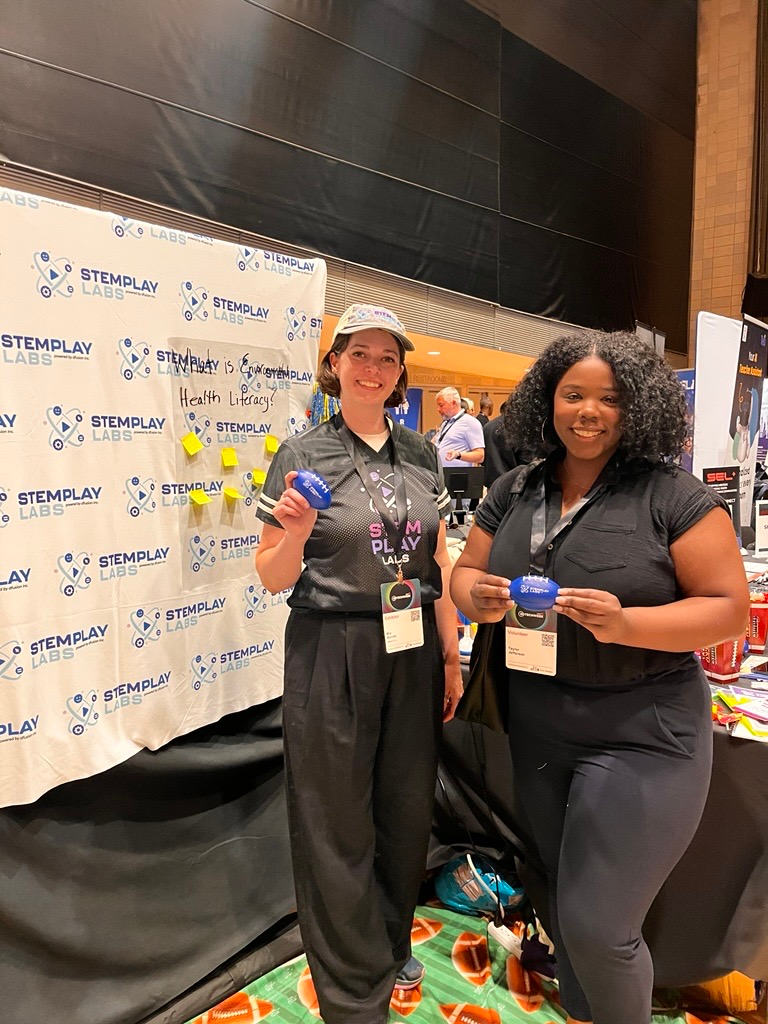
Insights from STEMPlayLabs time at EdTech Week 2025 at Columbia University
Teachers Are Excited. They’re Also Over It.
Walking through the halls of Columbia University during EdTech Week 2025, one thing became crystal clear: artificial intelligence – AI – has reached a turning point in education tools. Educators aren’t asking whether AI should be in the classroom anymore—they’re demanding to know how it can genuinely improve learning outcomes.

As Ben Kornell, co-founder of EdTech Insiders, wisely reminded us during the conference: “Focus on the Ed and then the Tech.” This simple statement cuts through the noise that has dominated education technology conversations for the past several years.
The AI tool Fatigue is Real
The conference revealed a growing tension: while AI education tools proliferate, teachers are increasingly skeptical of AI that prioritizes flashy features over meaningful educational impact.
Here’s what teachers told us they don’t want: – Another wrapper around ChatGPT claiming to be “innovative” or AI marketed as an outcome or impact in itself. They don’t want tools that ignore the fundamental relationship between teacher and student.
What they do want: – Teachers want technology that frees up time for meaningful relationships with students. They are open to using AI that expands creativity, analysis, and exploration and tools that help develop genuine 21st century skills.
The Student Preference Challenge
Students increasingly prefer AI education tools over teachers and human tutors because AI offers: – Easier access – Available 24/7 without scheduling – Hyper-personalization – Adapts to individual learning styles instantly – Non-judgmental support – No fear of appearing unintelligent – Autonomous learning – Self-directed at their own pace

This preference presents both a challenge and an opportunity for educators. As one presenter noted, this shift means teachers need to be more diligent about forming rapport with students that is trusting, non-judgmental, and hyper-personalized. In an AI-enabled world, humans need to be more human.
Innovation That Actually Matters
The most exciting AI projects at EdTech Week 2025 weren’t the ones with the most sophisticated algorithms—they were the ones solving real problems in creative ways.
Inverted Bloom’s Taxonomy Workshop
One particularly innovative session from folks at Playlab, Teaching Lab Studio, and Digital Promise, explored how AI can help students experience higher levels of Bloom’s Taxonomy earlier in their learning journey. Instead of following the traditional progression from remembering to creating, AI tools can scaffold complex thinking skills while simultaneously building foundational knowledge.
The session challenged attendees to: – Write topics and skills on cards – Create learning pairs – Determine how AI might support each combination – Identify which levels of Bloom’s Taxonomy learners would experience
This exercise revealed that well-designed AI tools can help students engage in analysis, evaluation, and creation—traditionally “advanced” cognitive skills—much earlier than conventional instruction allows.
From Content Curation to Learning Orchestration
The conference emphasized a critical mindset shift: AI has the potential to allow educators to move from content curation to learning orchestration mode. This means:
Instead of: Finding and organizing information for students

Focus on: Designing experiences where AI handles content delivery while teachers facilitate deeper learning connections
Instead of: Competing with AI for information delivery

Focus on: Building relationships and developing critical thinking skills that AI cannot replicate
AI Education Tools Focused on the Young Person
Several edtech tools at the conference stood out above the rest for their clear and passionate focus on supporting young people to create the lives they envision.
SEL-Plus
Mentors have an enormous positive impact on young people as they develop social emotional learning skills. SEL-Plus is supporting mentors to provide trauma-informed, data-backed connection with their young people through their new AI-empowered app, SELvie.
TomorrowToday
While many AI tools focus on academic content, innovative developers are exploring college preparation. These applications recognize that AI’s true value isn’t replacing human interaction—it’s enabling more meaningful human connections by handling administrative and routine tasks. TomorrowToday uses AI to supercharge educators’ capacity to provide career readiness support with progress trackers, automations, and interative digital portfolios.
Lumi Story AI: Democratizing Creative Expression
Colin Kaepernick’s Lumi Story AI stood out as a prime example of thoughtful AI implementation. Rather than just digitizing traditional methods, Lumi empowers students to create, illustrate, and publish their own stories—removing barriers to creative expression while maintaining student agency and ownership.
The Bottom Line: A Call to Edu-Action
EdTech Week 2025 made one thing abundantly clear: we’re ready for a new AI phase. The education community is ready to move beyond the hype cycle and into a new era where AI serves learning, not the other way around.
For educators and developers alike, the path forward requires:
- Evidence over excitement – Show learning outcomes, not just features
- Relationships over automation – Use AI to enable human connection, not replace it
- Equity by design – Ensure tools work for all students in all contexts
As we witnessed at Columbia University this October, the most successful EdTech innovations aren’t the ones that do the most—they’re the ones that empower teachers and students to do more together.
The future of AI education tools isn’t about technology replacing teachers. It’s about technology finally enabling teachers to do what they’ve always done best: inspire, guide, and transform young minds through authentic human connection.
Attending EdTech Week 2025 provided invaluable insights into the current state and future direction of educational technology. The conversations, presentations, and connections made at Columbia University this year will shape how we approach AI in education for years to come.
Want to learn more about the speakers and sessions mentioned in this article? – Visit EdTech Week for 2026 information – Follow Ben Kornell and Alex Sarlin on the EdTech Insiders podcast – Learn about Lumi Story AI
#EdTech #AIinEducation #EdTechWeek2025 #EducationalTechnology #TeacherProfessionalDevelopment #StudentEngagement #LearningEngineering #EdTechInnovation #K12Education