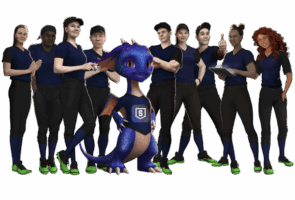
How do we help students see the relevance of STEM in their lives? Connect it to something they know, something they see, something they play! Baseball is a perfect opener for science and math learning.
Many educators and parents are looking for fun and engaging ways to inspire diverse learners in science, engineering, technology, and math (STEM) fields. Students need motivating educational resources to help them apply STEM in practical ways that make sense to them. Connecting math and science to games and sports can help show 4-6th graders how STEM is relevant in their lives. It can also transform so they see themselves as good at STEM and challenge stereotypes about who can be good at STEM.
STEMadium is the research-backed learning app built for 4th-6th graders that provides STEM education through baseball-related games. It has been proven to increase STEM knowledge scores during the school year and prevent students’ “Summer Slide” when the game is used in summer camps!
The game is a home run with students, with more than 90% saying they liked it as much or more than other educational games and 85% agreed they learned about math and 74% agreed that they learned about baseball.

STEMadium can be utilized in a variety of ways:
- Used as a supplement to classroom activities
- Implemented into an afterschool program/camp
- Given to students to use on their own time
STEMadium is mapped to math and science standards, making the game educational and fun. STEMadium is a narrative-based game with a plot and characters used to further understanding and connection to both the learning and the fun. There are 8 STEM training games that use math and science to train the baseball team’s players and raise their stats.
What makes STEMadium different from other educational apps?
When not completing the 8 training games, students can take breaks to explore the stadium – many things are interactive, so clicking around will result in finding coins and hidden features. Students can customize their character, baseball bat, and even the STEMadium itself with colors and signs. The students can also unlock and upgrade eight stadium attractions that are hidden within each training game. Each attraction has a unique explorable area, contains three puzzles to complete, and tells a unique story about a teammate.

Data from a randomized controlled trial of STEMadium
Overall improvement in math/science knowledge between pre/post. The mean number and percentage of math and science questions answered correctly improved significantly (p=.002). The average science score (a scale of science only questions) significantly improved from pre/post (p=.027).
Significant knowledge increase between pre/post
- Area of a triangle. There was significant knowledge increase on this topic, both in knowing the formula to calculate the area of a triangle (p=.005) and in success in calculating the area of a triangle with specific dimensions (p=.05).
- Understanding the forces that impact trajectory. There was a significant increase in the ability to identify all elements that impact trajectory of a hit baseball (.029).
- Angle/Trajectory/Force. There was a significant increase in scores on the question “What is the best launch angle for a ball with the same amount of force to go the farthest distance for a home run?” (p=.000).
Rounding. There was a significant improvement in rounding skills (rounding to nearest 100th) (p=.011). - Algebraic formula calculation. Significant increase in correct answers for the question “How many ounces should a bat weigh for a player who is 72″ tall?” (p=.006).
- Science: How a body reacts to stimuli. There was a significant increase in understanding of the order of stages in which a body reacts to stimuli (p=.000).
- Science/Nutrition. Understanding of the correct percentages for each food group significantly increased (p=.002)

Knowledge increases in specific groups
- More improvement in girls. The game showed a very large effect size on significantly improving the overall percentage knowledge score in girls. Girls scores on that variable improved 40% more than boys.
- Those who don’t do well in math. For those participants who scored less than 50% on the pre-test the increase in percentage of total knowledge questions correct was significant at p=.000 with an effect size of 6 (medium). The improvement in percentage of questions correct for this group was 70% greater when compared with the participant group as a whole.
- Perceived math competency for those who don’t do well in math. Among participants who were in the lowest 50% of self-reported math competency, there was a significant increase in their feelings about their math competency after completing the STEMadium intervention (p=.005, medium effect size).
- Math-related Career Interest Scale. Participants who ranked in the bottom 50% for the Math-Related Career Interest Scale at pre-test shows significant increases in their reported interested in math-related careers at the post test (p=.011, medium effect size, .4)
Baseball-related changes
- The app increased self-reported baseball knowledge. In all participants there was a significant increase in self-reported baseball knowledge (p=.004). Both girls (p=.038) and boys (p=.042) showed significant increases in their response to “I know a lot about baseball/softball”, with the effect size being larger in girls (.3 vs .2).
- App increased wanting to watch baseball/softball among girls. There was a significant increase in girls who reported wanting to watch baseball/softball games between pre and post tests (p=.056, medium effect size).
- The app increased interest in watching baseball the most among those who weren’t interested in baseball. Among the participants who reported being neutral or lower about watching baseball on the pre-test there was a significant increase in wanting to watch baseball/softball (p=.000) and this effect size was quite large at .7.

STEMadium is available in the app store. It was created by dfusion Inc. and Science of Sport with funding from the National Institute of General Medical Sciences (Grant No. R44GM130278).