Can playing fantasy football help middle school students learn fractions? According to a new independent study, the answer is yes.
Students who used Fantasy Sports Math League (FSML) significantly outperformed their peers in a comparison group on math assessments, and reported meaningful gains in their confidence solving fraction-based equations.
Spring 2026 QED Findings
Arroyo Research Services, an education research firm, just completed a quasi-experimental design (QED) study evaluating Fantasy Sports Math League (FSML), a web-based game from dfusion, Inc. that uses fantasy football to teach middle school math. The study and product development was funded by the Institute of Education Sciences Small Business Innovation Research (SBIR) program and ran during the Spring 2026 semester.
How the Study Worked
Six teachers and more than 200 middle school students across Pennsylvania and Connecticut took part. Researchers compared a treatment group that used FSML in the classroom against a comparison group that didn’t, while controlling for differences in starting math scores, grade level, gender, and race/ethnicity. In total, 133 students had complete, matched pre- and post-survey data included in the final analysis.
Students took an 11-item math assessment aligned to 6th grade standards (fractions, decimals, order of operations, and problem-solving) both before and after the six-week study period, along with a battery of questions measuring their math confidence and interest.
- Participation in FSML was associated with math post-test scores 13 percentage points higher than the comparison group, a statistically significant result (p = .004) even after accounting for prior performance and demographic differences.
Students Who Played FSML Scored Higher on Math Assessments
- The treatment group also showed a statistically significant improvement in their own scores from before to after using FSML (p = .02). The comparison group’s scores did not show a meaningful change over the same period.

Fraction Confidence Went Up, Too
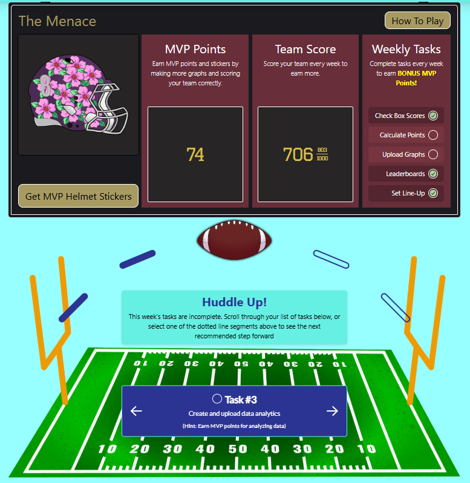
FSML is built around calculations that require working with fractions — averaging weekly scores, splitting a budget across players, and more. That design paid off:
- students in the treatment group reported a statistically significant increase in their confidence solving equations with fractions (p = .05), while the comparison group’s confidence levels didn’t change significantly.
Drafting their Fantasy Football Team was Fun
“FSML made me more confident in my math skills, and it also made math significantly more enjoyable.” ! 6th grade student
Even in the last weeks of school before summer break, students stayed engaged with the math learning game and shared how they felt about the experience:
- 52% said they would recommend FSML to other students, and another 33% said they might.
- 53% rated their enjoyment of FSML a 4 or 5 out of 5.
- 40% said FSML helped them understand math concepts at a 4 or 5 level.
- The most commonly cited skills students felt they practiced were multiplying fractions, adding and subtracting fractions, and solving equations.
- Students’ favorite parts of the game were drafting their teams and competing with classmates.
“FSML made me realize that math is used in jobs and activities.” ~ 6th grade student
What Teachers Saw in the Classroom
Teachers implemented FSML in a variety of settings, from STEAM electives to self-contained 6th grade classrooms, typically as a supplement to their regular math instruction rather than a full replacement. On average, intervention teachers spent about five weeks running FSML with their classes at the end of the school year.
Teachers reported the strongest engagement among students involved in athletics — both boys and girls — while engagement among quieter students or those with lower initial interest in math was more mixed. Teachers also pointed to graph interpretation, data analysis, and equation-writing as areas where they saw the clearest student growth.
The participating teachers are excited to use FSML in the fall, when the game will run during the live NFL season (the study was conducted with “FSML Flashback Football” that uses historical-data during the NFL off-season).

The Goal Line
This study adds to the evidence that game-based, real-world learning tools like Fantasy Sports Math League can move the needle on both math achievement and student confidence — particularly around fractions, an area where middle schoolers frequently struggle. With a full NFL season ahead this fall, there’s reason to expect even stronger engagement when FSML runs with live, weekly game data.
For more information about the full study, including detailed methodology and survey results, please contact BA Laris @ ba.laris@dfusioninc.com