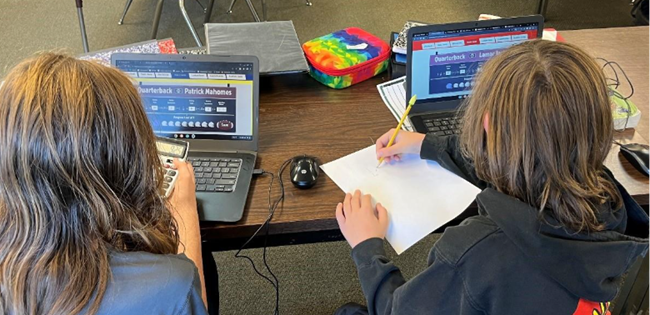
Why do middle school students struggle with fractions? Are they confusing the numerator and denominator? Do they understand equivalent fractions? Are they using addition instead of multiplication?
Or is it something else? Research suggests there’s often something shaping their math readiness before students even pick up a pencil…and these ontogenic obstacles may be one of the most underappreciated drivers of the math achievement gap.
The math crisis has a foundation problem
The national math achievement data is hard to ignore. Only 28% of 8th grade students performed at or above proficient on the 2024 National Assessment of Educational Progress — the largest decline since assessments began. And while it’s tempting to point to specific topics as the culprit, a recent analysis by the Learning Agency offers a more uncomfortable diagnosis: the struggle isn’t really about the math. It’s about the foundational gaps that were never filled.
Because mathematics builds cumulatively, students who struggle with algebra may be facing unresolved challenges with fractions, number sense, or other skills typically developed in earlier grades. Fractions, in particular, sit at the center of this cascade. Students who leave middle school without fraction fluency arrive in algebra already behind — not because algebra is too hard, but because the floor beneath it was never solid.
Three kinds of obstacles — and one that gets overlooked
A 2024 scoping review of fraction learning research identified three distinct types of obstacles that prevent students from mastering fractions (Sari et al., 2024):
Epistemological obstacles arise from gaps in conceptual understanding — students who have memorized procedures without grasping what the numbers actually represent. This could be trying to add fractions like whole numbers, when this logic does not apply.
Didactic obstacles stem from how fractions are taught — instructional approaches that emphasize steps to follow rather than grasping the meaning behind the steps, or moving too quickly through foundational concepts before students integrated the learning.
Ontogenic obstacles are different from both. These arise from a student’s mental readiness — their psychological and emotional relationship with the mathematics itself. They include math anxiety, low confidence, and the belief — often formed early and hardened by repetition — that they are simply not a math person.
Of the three, ontogenic obstacles are the hardest to see in a gradebook and the easiest to overlook in curriculum design. A student who is anxious about math may shut down before they even attempt the problem. A student who believes they can’t do fractions may not try hard enough to discover that they can. The obstacle isn’t in the math — it’s in the space between the student and the math.

What students say about their own math readiness
At STEMPlay Labs, we have been studying this in real classrooms through our Fantasy Sports Math League (FSML) — a game-based math supplement for grades 6–8 in which students manage a fantasy football team using real NFL statistics, solving fraction and decimal equations each week to score their team’s points.
In our Fall 2025 pilot with 144 students across 9 teachers in 5 states, we asked students open-ended questions about their experience — not just whether they learned fractions, but how they felt about math before, during, and after the program.
The student comments give a clear picture:
“Playing FSML changed how I feel about math class and made me feel more motivated, and math used to be my least favorite, and then that changed.” 6th grade girl
“It made me love math and encourage me to learn more.” 6th grade boy
“I feel more mathematic.” 6th grade boy
“It makes me a little bit more comfortable with fractions.” 7th grade girl
“It was fun solving my players score every Tuesday.” 8th grade girl
And perhaps most tellingly, when we asked students what they felt proud of — what they wanted to brag about — many of them led with fractions:
“I did really well on adding negative numbers, helping other people, and getting faster at adding fractions.” 6th grade girl
“Playing Fantasy Sports Math League I drafted a good team, with good backups and my fraction sore calculation was second to none.” 6th grade boy
“I am great at doing the fractions and setting a good line up.” 6th grade girl
These responses point to something that test scores alone can’t capture: students who came in with an ontogenic obstacle — anxiety, low confidence, the belief that fractions were beyond them — and left with a different relationship to math. Not just more skills, but more access to their own capability.

Why this matters for teachers and parents
Mental readiness is not a fixed trait. It’s not something students either have or don’t have. It’s a state that can be shifted — by the right context, the right entry point, the right experience of succeeding at something they expected to fail.
What that means practically is that the solution to ontogenic obstacles isn’t more drill and practice. It’s changing the conditions under which students encounter the math. When the stakes feel lower, when there’s a reason to care about getting it right, when failure is reframed as part of the process rather than evidence of inability — the floor starts to feel more solid.
“I learned that math is easier with practice.” 8th grade boy
Teachers already know this. The challenge is finding ed-tech tools that make this come alive in the classroom.
When a student is calculating fractions to score their fantasy team’s weekly points — when the math is connected to something they care about, when they can try again without penalty, when their classmates are doing it too — the ontogenic obstacle has less room to operate. The anxiety is still there for some students. But the game creates enough motivation and enough low-stakes repetition that students move through it rather than stopping in front of it.
Use Fantasy Sports Math League with your Middle School Students
Our pilot data showed a statistically significant increase in fraction confidence (p<.001) and a significant decrease in fraction anxiety (p=.044) across the season. Students who started with the lowest confidence made the largest gains. That is the ontogenic obstacle being addressed — not through a mindset curriculum or an anxiety intervention, but through a math game that made students want to keep trying.
If you’re a teacher looking for a way to meet students where their relationship with math actually lives — not just where their skill gaps are — we’d love to show you what it looks like in a classroom.

Learn more about FSML or Request a demo @fantasysportsmathleague@dfusioninc.com
About the Author, BA Laris, MPH, Director of STEMPlay Lab, Principal Investigator of Fantasy Sports Math League: I was that kid in middle school. I was “not a math person.” I definitely re-played the line “I just don’t get it.” And look at me now, many decades later, I can proudly say, “I am a math person!” I develop and test educational technology to help middle schoolers come to that conclusion that it took me too long to get to! Making learning engaging and meaningful drives the work we do at STEMPlay Labs.