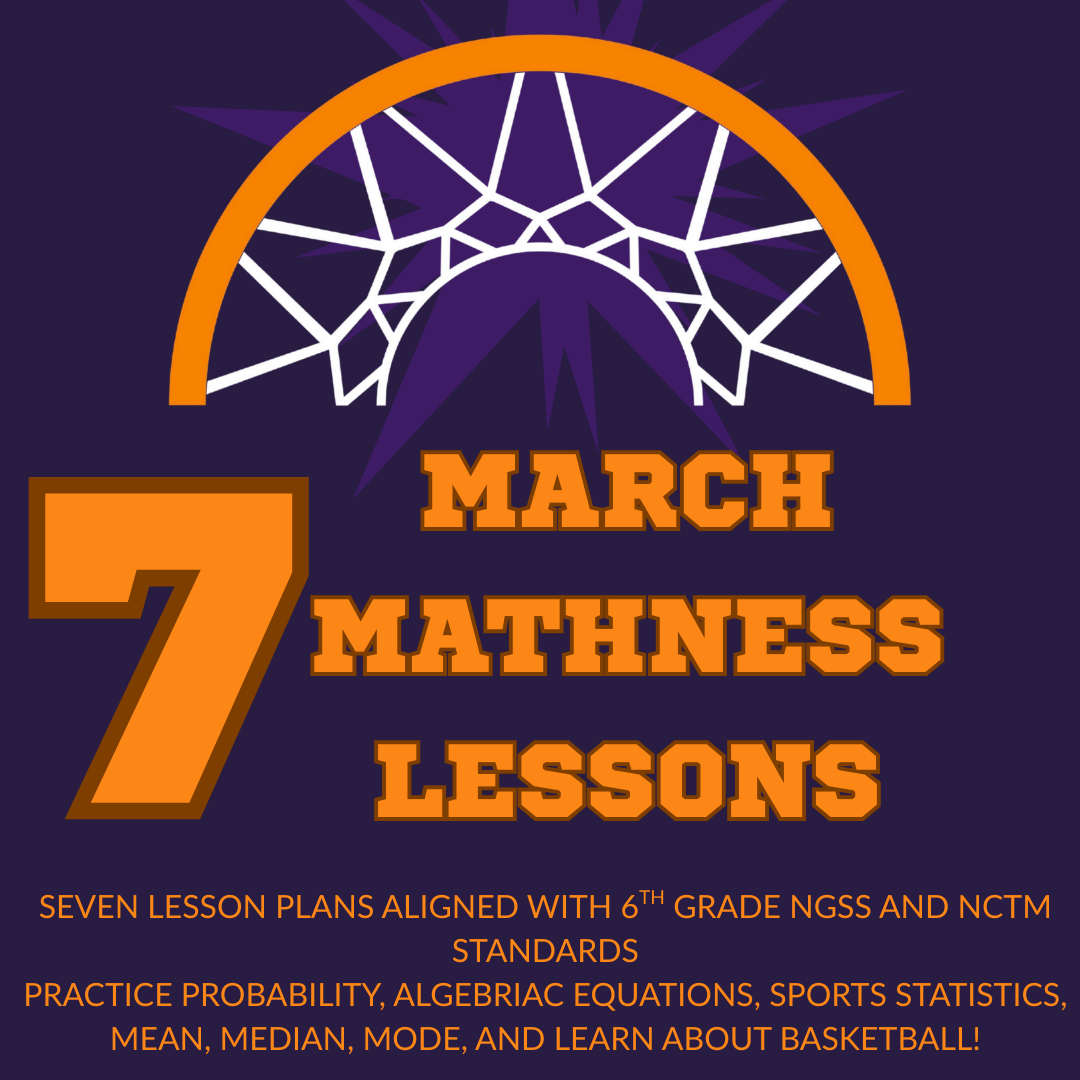
Every spring, millions of people fill out brackets, debate upsets, and obsess over college basketball statistics during the NCAA Basketball Men’s and Women’s Tournament March Madness. What if we could harness that excitement to teach essential math concepts? That’s exactly what STEMPlay Labs Teacher Insiders are doing with Fantasy Sports Math League’s March Mathness. Here are 7 exciting math lessons that transform the NCAA March Madness into fun math learning for middle school students.
Why March Mathness?
Students often struggle to see how classroom math applies to real life. March Mathness bridges that gap by using real data from March Madness, one of the most popular college sporting events of the year. The curriculum taps into students’ natural enthusiasm for competition and sports while reinforcing critical mathematical skills.

Preview Marh Mathness Lessons
STEMPlay Labs Teacher Champions are using the 3 units this March.
- Understanding Tournament Brackets (3 Lessons)
Students dive into probability, ranking systems, and prediction. They analyze how teams are seeded, explore why upsets happen, and practice making evidence-based predictions. Key vocabulary includes concepts like “equally likely,” “upset,” and “elimination,” all within the context of actual tournament matchups. They discover that while higher-ranked teams are likely to win, basketball is full of surprises—which leads to rich discussions about probability.
- Drafting Players Based on Statistics (3 Lessons)
Here’s where the math gets exciting. Students learn to evaluate players using real statistics like field goal percentage, rebounds, turnovers, and free-throw rate. They then substitute these values into an algebraic expression to calculate each player’s “impact score”:
0.5(w) + 0.15(x) + 0.15(y) − 0.25(z)
Where:
- w = field goal percentage
- x = rebounds
- y = free-throw rate
- z = turnovers
This hands-on application reinforces order of operations, working with fractions and decimals, substitution, and multi-step problem solving, all while students debate which players and teams will get them to the top of the leaderboards.

- Cost of Attending Games (1 Lesson)
In this data analysis lesson, students research actual tournament game ticket prices across different seating areas and tournament rounds. They calculate mean, median, and mode for seating sections, then determine which measure of central tendency best represents ticket costs in each area. This lesson connects math to budgeting and consumer decision-making.
Key Learning Outcomes
Across all seven lessons, students develop:
- Conceptual understanding of probability, statistics, and data analysis
- Procedural fluency with operations, fractions, decimals, and algebraic expressions
- Application skills through real-world problem solving
- Critical thinking about when rankings and statistics are reliable predictors
- Communication skills by explaining their reasoning and defending their choices
Flexible Implementation for Your Classroom
One of the greatest strengths of March Mathness is its adaptability. Teachers don’t need to commit to all seven lessons—you can pick and choose the units that best align with your current curriculum and time constraints. Focusing on probability? Use the bracket lessons. Teaching algebraic expressions? Jump straight to player drafting. Need a engaging data analysis activity? The ticket pricing lesson works beautifully as a standalone.
To maximize student excitement and build classroom community, the curriculum includes suggestions for implementing a class-wide leaderboard. As students make bracket predictions, draft players, and complete math challenges, their scores can be displayed throughout the tournament. This transforms individual math work into a shared classroom experience. Students check scores together, debate strategy, celebrate correct predictions, and learn from unexpected outcomes—all while reinforcing mathematical concepts. The friendly competition keeps engagement high across multiple weeks, and even students who aren’t traditionally “math people” find themselves invested in the numbers.
“Playing changed how I feel about math class and made me feel more motivated, and math used to be my least favorite, and then that changed.” – 6th grade student, Connecticut
Get in the Game
March Mathness is designed for 6th-grade classrooms, adaptable for grades 5-8. Each lesson includes:
- Detailed teacher instructions with timing
- Student recording sheets and worksheets
- Vocabulary lists
- Assessment opportunities through student reflections
March Mathness proves that math doesn’t have to be abstract or disconnected from students’ lives. By leveraging the excitement of NCAA basketball, this curriculum shows students that math is the language we use to analyze, predict, and understand the world around us.
Interested in trying March Mathness with your students? Become a STEMPlay Labs March Madness Insider!
We’re offering FREE early access to all 7 March Mathness lessons for innovative teachers who want to transform their math classroom this tournament season.
“It helps students to expand their math participation without realizing it’s math. That’s why I think this is such a great program!” – 6th grade teacher, Missouri
As an early adopter, you’ll get:
- Complete lesson plans, student worksheets, and teacher guides at no cost
- Priority support from our education team
- The opportunity to shape future versions with your feedback
- Exclusive offers to our upcoming STEM game-based learning resources
Spots are limited—this free offer is only available through March 18, 2026. Join the teachers bringing game-changing math to their students.
Sign Up for Free Access and then let us know what you think!
About the Author: BA Laris, MPH is the Director of STEMPlay Labs and is passionate about broadening participation in STEM fields through game-based learning that makes content accessible, engaging, and relevant—proving that being “silly and fun” makes teaching and learning stick. Connect on LinKedIn or @ba-laris